
|
|
Rules of bicycle polo in the Bicycle Polo Association of America (B.P.A.A.) |
These bike polo rules are governed by the Bicycle Polo Association of America (Aiken, South Carolina, U.S.A.):
A. A regulation playing field shall be 120 yards in length and 60 yards in width. Fields of slightly smaller dimensions (e.g. football or soccer fields) may be used, but in no case should the field be smaller than 100 yards in length and 50 yards in width.
B. The boundaries on the sides of the field shall be known as the Side Lines; the boundaries on the ends of the field shall be known as the End Lines; the part of the End Line between the goal posts shall be known as the Goal Line. All boundaries shall be clearly marked with either chalk or paint; string is not an adequate marker as it can become entangled in bicycles and mallets.
C. The goal posts shall be placed 12 feet apart on each End Line, and shall be equidistant from the Side Lines. The posts must be at least six feet in height, erected in such a way as to be easily knocked over if collided with, and made of a material light enough as not to constitute a hazard to the players, yet strong enough so as not to be moved or bent by the wind.
D. The field shall be surrounded by a Safety Zone of at least 10 feet on all sides, which must be kept clear of all spectators, photographers, equipment, and other hazards. This is a very important rule; where space limitations exist, the playing field should be made smaller in order to provide an adequate Safety Zone. The outer boundary of the Safety Zone may be marked with cones, ropes, or a line of chalk or paint.
E. The Field shall be further marked as follows:
1. A Half Line, equidistant from the End Lines, running the full width of the field;
2. A Center Line, equidistant from the Side Lines, running the full length of the field;
3. Two 30-yard Lines: one 30 yards from each End Line, running the full width of the field;
4. A Center Circle, with a radius of 15 yards and its center at the intersection of the Half Line and the Center Line;
5. Two semi-circles: one at each end of the field, with a radius of 15 yards and its center at the intersection of the Center Line and the Goal Line; these areas to be known as the Goal Creases.
A. Bicycles of any type may be used, but a player may be required to remove any equipment which may be hazardous to another player.
B. Mallets shall not exceed an overall length of 36 inches. The cane may not exceed one inch in diameter. The head may not exceed three inches in diameter, nine inches in length, and ten ounces in weight.
C.The ball shall be not less than 12.5" or more than 15" in circumference and not less than 170 grams or more than 182 grams in weight. In a bounce test from 9' on concrete at 70ºF, the rebound should be a minimum of 54" and a maximum of 64" at the inflation rate specified by the manufacturer.
D. Each player must wear a protective helmet, which must be secured to the head in such a way as to preclude its becoming dislodged in a fall. Protective facemasks and/or goggles are recommended, but not required. E. Any other equipment, such as shin, knee, or elbow guards, must be of such design and material so as not to constitute a hazard to other players.
A. Number of players on team: No team may have more than six members in total, all of whom must be named before that team begins play. All players must be current members of the BPAA.
B. Number of Players on Field: No team may have more than four players on the Playing Field while the ball is in play. Tournaments may be held with fewer than four players per team allowed on the field, but in no case may the limit be less than two. Tournaments may also be held which limit the number of male or female players on the field.
C. Team colors: Each team must have two sets of shirts, each set to include a different numbered shirt for each member of the team. The shirts in each set must be identical in color and pattern, and have clearly visible numbers at least ten inches high on the back and four inches high on the front. Color-coordinated shorts, helmets, pads, and numbers on the sleeves are optional, but recommended. Any sponsors’ logos must be configured in such a way as not to interfere with the legibility of the players’ numbers. The two sets of shirts must be sufficiently different in color and pattern as to enable the team to avoid having to wear shirts which cause confusion with their opponents’ shirts.
D. Conflicting Colors: If, in the opinion of the officials, two teams’ shirts are so alike as to cause confusion, the team lower in the draw shall be required to switch to their other set of shirts. If there is no way to determine which team is lower in the draw, a coin flip shall decide which team shall change shirts.
E. Substitutions:
1. Between Periods: Substitutions may be made between periods, but a team making such substitutions must remain within any limitations regarding number of male or female players on the field.
2. Injured player:
a. If a player is unable to continue play due to injury or illness, a substitution may be made during a period. If possible, a team should still remain within any restrictions on the number of male or female players on the field, but a female player may be substituted for a male player in this situation.
b. Any player who leaves the game due to injury or illness may not return to the game until the end of the the period following that during which the player left the game. (e.g. if a player leaves the game during the second period due to injury, he or she may not return to the game until after the third period.)
c. If a player is injured by a foul, a Penalty 4 may be appropriate; see Penalty 4.
F. Captains:
1. Each team shall designate one player as its Captain, who shall have the sole right to discuss any matter with the Referee.
2. If a team’s Captain is not on the field, an Acting Captain shall be designated from among the players on the field until the Captain returns to the field.
A. Referee:
1. In all tournament games, an official Referee shall be employed, whose decisions shall be final, subject to Rule XI (Protests).
2. The Referee shall be the only official with the authority to stop play with his whistle:
a. The Referee may stop play in the event of any violation of the Field Rules and award a penalty, or declare offsetting penalties;
b. The Referee shall stop play if a Goal Judge or Side Judge indicates that the ball has gone out of play, or that a goal has been scored.
c. The Referee shall stop play if a player is injured to the extent that he does not continue play.
3. The Referee should be on foot, rather than mounted on a bicycle, in order to give him the freedom to move quickly in any direction.
4. Whenever possible, the Referee should not be a member of any team in the tournament; if no independent Referee is available, a player from a team already eliminated from contention should be employed whenever possible. (i.e. in all but the first game of an elimination event)
B. Goal Judges: There shall be a Goal Judge, equipped with a flag and several spare balls, at each end of the field, who may be called upon by the Referee to give testimony regarding events within that half of the field, including, but not limited to:
1. Whether the ball has passed between the goal posts, over the Goal Line, or over the End Line; and which team touched the ball last:
a. If the Goal Judge believes that the ball has passed between the goal posts and over the Goal Line, he shall raise his flag above his head;
b. If the Goal Judge believes that the ball has passed over the End Line, and was last touched by the attacking team, he shall point the flag to the side of the goal where he believes the ball crossed the End Line, and place a ball at the point on that side of the goal where the End Line intersects the Goal Crease semi-circle;
c. If the Goal Judge believes that the ball has passed over the End Line, and was last touched by the defending team, he shall wave the flag vigorously below his waist.
2. Any events which may have occurred while the Referee’s attention was focused elsewhere, but of which the Goal Judge feels the Referee should be made aware.
C. Side Judges: There shall be at least two, and preferably four, Side Judges, evenly divided between the two sides of the field. The Side Judges shall also be equipped with flags and several spare balls, and may be called upon by the Referee to give testimony as to events near their side of the field, including, but not limited to:
1. Whether the ball has crossed the Side Line: If the Side Judge believes that the ball has crossed the Side Line, he shall point his flag in the direction of the goal defended by the team which he believes last touched the ball, and place a ball on the Side Line at the point where he believes the ball crossed it.
2. Any events which may have occurred while the Referee’s attention was focused elsewhere, but of which the Side Judge feels the Referee should be made aware.
D. Timekeeper: There shall be a Timekeeper, who shall keep track of the elapsed time during a period, and notify the Referee of the time remaining whenever called upon to do so.
E. Scorer: There shall be an official Scorer, who shall keep a record of goals scored, the time at which they were scored, the players who scored them, and any other statistics deemed appropriate by the Tournament Committee.
F. Announcer: In the event that a loudspeaker system is used, the Announcer shall not be considered an official, and shall not comment on any rulings by the Referee or other officials, other than to explain what those rulings are. If the Announcer questions or disputes any rulings by the Referee or other officials, the Announcer shall be replaced.
A. Number of Periods:
1. A game shall consist of an even number of Periods, with a minimum of two and a maximum of six.
2. The Tournament Committee shall set the number of Periods for games in an event based on the number of teams entered and the time available to complete the required number of games.
3. The semi-finals and/or finals may consist of more Periods than games in previous rounds, with a maximum of two additional Periods, not including any overtime Periods.
B. Duration of Periods:
1. Regulation Periods shall be 10 minutes in duration.
2. In the event of a tie score at the end of the last Regulation Period, any Overtime Periods shall be 5 minutes in duration, and the full 5 minutes shall be played, regardless of the number of goals scored, until one team is leading at the end of a Period.
3. The clock shall be stopped whenever the Referee blows the whistle, and started when the ball is hit or hit at.
4. The timekeeper shall ring a bell when 30 seconds remain in any Period, and sound a horn when time expires. The Period is deemed to have ended when the horn is sounded, rather than when the Referee blows the whistle.
C. Time Between Periods:
1. There shall be a 10-minute break between the two middle Periods of a game, which break will be known as Half-Time;
2. There shall be a two-minute break between all other Periods, including between the last regulation Period and the first overtime Period, and between overtime Periods.
A. Teams shall be present at the time their games are scheduled to be played.
B. Choice of Ends: Prior to the start of a game, the Captains of the two teams shall meet with the Referee, who shall allow one Captain to choose one of two equally likely choices (e.g. odd or even number of fingers behind his back; heads or tails of a coin flip). If the Captain chooses correctly, he will have the option of choosing which goal to defend in the first Period, or of choosing which goal to defend in the first Period after Half- Time. If he opts for the former choice, the Captain of the other team will be given the latter choice, and vice versa.
C. Change of Ends: In all other Periods, each team will attack the goal which it defended during the previous Period. This provision also applies to any overtime Periods.
A. The Sprint: Before any Sprint, each team shall designate one player as its Sprinter. At the beginning ofeach period, and after each goal (other than goals awarded by Penalty 1), each Sprinter shall position himself outside the Center Circle, with the Center Line on his right and the goal his team is defending behind him. A ball shall be placed at the intersection of the Center Line and the Half Line. When the Referee says “Play,” the Sprinters may enter the Center Circle and attempt to gain possession of the ball, but each must keep the Center Line on his right until the ball is hit or hit at.
B. Other Players: All other players must be on the same side of the Half Line as the goal their team is defending until the Referee says “Play,” at which time they may cross the Half Line. No player other than the Sprinters may enter the Center Circle until the ball has been hit or hit at by one or both of the Sprinters. All players except the Sprinters may be moving before the Referee says “Play.”
C. False Start:
1. If one team violates the procedure set forth in parts A and B, the Referee shall award a Penalty 2 to the other team, the free shot to be taken from the center of the Center Circle;
2. If both teams violate the procedure set forth in parts A and B, another Sprint shall be held, with either team free to designate a different Sprinter.
A. How Scored
1. A goal shall be scored when, in the opinion of the Referee, the ball has passed over and clear of the Goal Line between the goal posts, or the imaginary lines created by extending their inner edges upward. The Referee may rely on the testimony of the Goal Judge or players to help him determine whether a goal was scored, but the Referee's decision shall be final.
2. A goal awarded by Penalty 1 shall count as a goal scored.
B. How Credited
1. Credit for a goal scored shall be given to the last attacking player to touch the ball prior to its crossing the Goal Line. If no attacking player touched the ball prior to the goal being scored, credit for the goal shall be given to the attacking player nearest the goal when the goal was scored.
2. Credit for a goal awarded by Penalty 1 shall be given to the player fouled.
C. How Play Resumed: After a goal is scored, a Sprint shall be held at the center of the field under the same conditions as at the start of the game, with each team free to designate any player as their Sprinter.
D. Determination of Winner: The team which has a higher total of goals scored at the end of the game shall be declared the winner of the game.
A. If the ball goes over and clear of the Side Line:
1. The team which did not touch the ball last shall be awarded a free hit from the point where the ball crossed the Side Line, but may not hit or hit at the ball until the Referee says “Play.”
2. The members of the team which touched the ball last must position themselves at least 10 yards from the ball until the Referee says “Play” and the ball is hit or hit at.
B. If the ball goes over and clear of the End Line outside of the goal posts:
1. If the ball was last touched by the attacking team:
a. The defending team shall be awarded a free hit from the point where the End Line intersects the Goal Crease semi-circle on the side of the Goal where the ball crossed the End Line, but may not hit or hit at the ball until the Referee says “Play.”
b. The members of the attacking team must position themselves outside the 30-yard Line until the Referee says “Play” and the ball is hit or hit at.
2. If the ball was last touched by the defending team, a Penalty 3 shall be awarded to the attacking team.
C. The Referee shall have the sole right to determine whether the ball has crossed the Side Line or End Line, and players should continue play unless they hear the Referee’s whistle. The Referee may rely on signals from the Side Judges or Goal Judges in determining whether a ball is out of bounds.
A player must have both feet off the ground when hitting at the ball or hooking an opponent. A player may block the ball with his bicycle while one or both of his feet are on the ground, provided that he does not violate any other rules, particularly the Right of Way rules, in so doing.
A. The Line of the Ball:
1. At all times when the ball is in play, the line of its course shall be called the Line of the Ball. Any change in the ball’s direction, however slight, shall create a new Line of the Ball.
2. If the ball is put in play by being hit at and missed, as on a free hit, the Line of the Ball shall be the direction in which the player was riding when he hit at the ball.
B. The Right of Way:
1. The Line of the Ball shall determine a Right of Way between any two or more players in the vicinity of the ball, which Right of Way shall give the player entitled to it the right to ride up to and past the ball.
2. No other players may enter, block, or cross that Right of Way except at such a distance that there is no danger of collision with the player or players entitled to the Right of Way.
C. Determination of Right of Way:
1.If two players are both following or both meeting the ball:
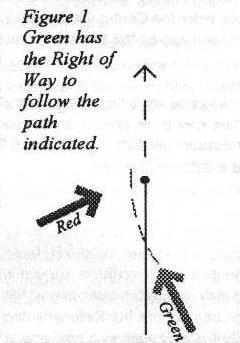
a. If one player is clearly approaching the line at a lesser angle, then that player has the Right of Way over the player approaching at a greater angle. (Fig. 1)
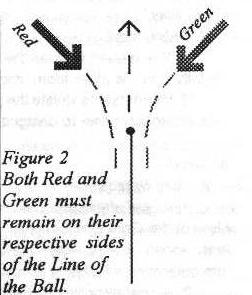
b. If the two players are approaching at approximately equal angles from opposite sides of the line, then each must remain on his respective side in playing the ball. (Fig. 2)
2. If one player is following and the other meeting the ball:
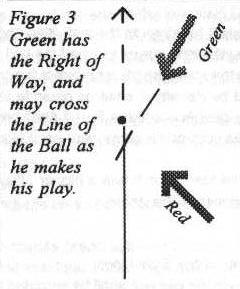
a. If one player has the Line of the Ball on his right, and the other player has the Line of the Ball on his left, the player with the Line of the Ball on his right has the Right of Way. (Fig. 3)
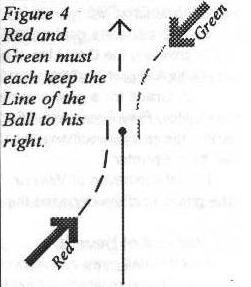
b. If both players have the Line of the Ball on their right, then each must keep the Line of the Ball on his right until clear of the other player. (Fig. 4)
c. If both players have the Line of the Ball on their left, then the player following the ball has the Right of Way, and may cross the Line of the Ball to play the ball on his right. (Fig. 5) Should the player following the ball elect to play it on his left, the player meeting the ball may also make a play on his left.

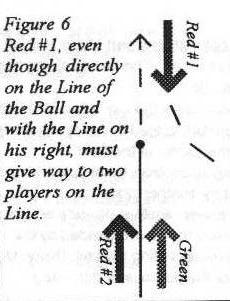
3. Two players riding parallel to one another and in the same direction toward the ball shall have the Right of Way over a single player riding at an equal or greater angle to the Line of the Ball, regardless of which side of the Line of the Ball the single player is on. (Fig. 6)
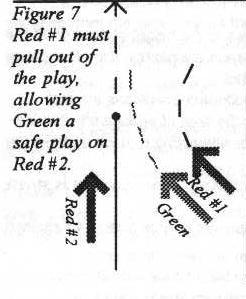
4. Two players riding parallel do not have the Right of Way over a single player riding at a lesser angle to the Line of the Ball. (Fig. 7) In this example, the Red #1 would create a dangerous situation if he forced the Green player into Red #2's Right of Way. Note that if Red #1 pulls out of the play, Green can turn parallel with the Line of the Ball and play the ball on his left without fouling Red #2.
5. Two players riding parallel must ride on opposite sides of the ball, each allowing the other to make a play.
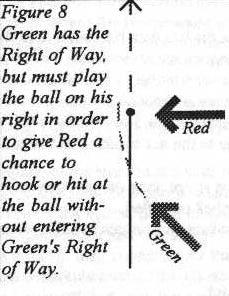
6. A player with the Right of Way and an opponent on his right must play the ball on his right side, in order to give the opponent an opportunity to make a play. (Fig. 8) In such a case, the oppnent must make his play without entering the Right of Way in front of the player, but may cross behind the player, provided he is not violating the Right of Way of any following player.
7. No dismounted player may block the ball with his bicycle if in so doing he creates a danger of collision with a player riding from any direction.
8. When the Line of the Ball changes for any reason, a player on the new Right of Way must give other players an opportunity to clear the new Right of Way, but players clearing the new Right of Way may not make a play on the ball.
A. A player may block the ball with any part of his body or equipment, but may not direct the ball with anything other than his mallet. The hand holding the mallet shall be considered part of the mallet for purposes of this rule.
B. No player may intentionally carry the ball against his body or in his equipment.
C. If a ball accidentally becomes lodged in a player’s equipment, the Referee shall stop play and a Sprint shall be held at the center of the field.
D. No player may hit the ball more than three times consecutively, unless:
1. The ball is hit or hit at by another player;
2. The ball hits another player, another player’s equipment, or the Referee.
3. The player is riding toward the Goal defended by the other team, and no defending player is closer to that Goal than the player hitting the ball. (Note: Unsuccessful attempts to hit the ball shall not be counted as hits for the purpose of this rule.)
A. A player may hit or block the ball with his mallet regardless of the height of the ball off the ground, but may not swing dangerously or recklessly if other players are nearby. If another player is inadvertently struck by a player’s mallet, a foul shall be called.
B. A player may hook or strike an opponent’s mallet if the following conditions are met:
1. The point of contact between the two mallets is below the level of opponent’s shoulder.
2. The opponent is either in the act of hitting at the ball or attempting to hook or strike the player’s mallet.
3. The hooking or striking is not done dangerously or recklessly. If the opponent is struck by the player’s mallet, a foul shall be called.
C. If a player intentionally strikes or attempts to strike an opponent with his mallet, a Penalty 5 shall be called.
A. No player may intentionally make contact with an opponent with any part of his body or equipment.
B. No player may make any action, either physical or verbal, intended to induce an opponent to refrain from making a play which that opponent could have made without violating these rules.
C. No player may verbally abuse any official, or use profane language toward any opponent or official.
A. Penalty 1
1. If a foul is called against a team within the Goal Crease surrounding the Goal defended by that team:
a. The team fouled shall be awarded a goal;
b. A Sprint will be held with the ball placed at the intersection of the Center Line and the Goal Crease semi-circle; the Sprinter for the fouling team shall start from the Goal Line, and the Sprinter for the team fouled shall start from the 30-yard Line; each must stay to his left of the Center Line.
c. All other players on the defending team must position themselves behind the End Line until the Referee says “Play,” and they may not ride onto the field across the Goal Line.
d. All players on the team fouled must position themselves outside the Goal Crease until the Referee says “Play”.
2. If the fouling team violates the procedure set forth in part 1:
a. If a goal is scored by the team fouled as a result of the Sprint, the goal shall be counted and play resumed with a Sprint at the center of the field.
b. If no goal is scored on the Sprint, the Referee shall award a Penalty 2 to the team fouled.
3. If the team fouled violates the procedure set forth in part A, the fouling team shall bring the ball into play with a free hit from the center of their Goal Line.
4. If both teams violate the procedure set forth in part A, another Sprint shall be held, with each team free to designate a different Sprinter.
B. Penalty 2
1. If a foul is called outside the Goal Creases, the team fouled shall be awarded a free hit from the point of the infraction, with no member of the fouling team within ten yards of the ball when it is hit or hit at.
2. If the fouling team violates the procedure set forth in part A, and a player within ten yards of the ball interferes with the free shot, the team fouled shall be awarded another Penalty #2 from the point where the offending player touched the ball.
C. Penalty 3 (Safety)
1. If the ball crosses the End Line, having last touched a defending player or any of a defending player’s equipment:
a. The attacking team shall be awarded a free hit from the point on the Half Line an equal distance from the Side Line as the point where the ball crossed the End Line;
b. All members of the defending team must position themselves at least ten yards from the ball until it is hit or hit at.
2. Same as Penalty #2B
D. Penalty 4
1. If a player is injured by a foul to the extent that the Referee either allows or requires his retirement from the game:
a. The Captain or Acting Captain of the team fouled shall have the option of designating a player from the fouling team to be removed from the game, and continuing the game with one fewer players on the field for each team; if the injured player is female, the player designated by the team fouled for removal from the game must also be female.
b. In the alternative, the team fouled may substitute for the injured player. If the injured player is female, the team fouled must substitute another female player, if one is available; if none is available, a male player may then be substituted. The fouling team must continue to abide by any restrictions regarding male and female players.
E. Penalty 5
1. If a player commits repeated fouls, commits a dangerous and deliberate foul, or engages in conduct which the Referee feels is not in the best interest of the game, the Referee may remove that player from the game for any length of time he deems appropriate, including the remainder of the game, and mayeither permit or prohibit substitution for the offending player during the time he is absent from the game.
2. If a player continues to engage in such conduct, the Referee shall require the player to be removed from the remainder of the game.
3. If a player incurs more than two Penalty 5's in one tournament, that player shall not be eligible for play in the remainder of the tournament.
F. Penalty 6
If a team is not present at the time a game is scheduled to begin; if a team's Captain refuses to allow his team to continue play; if a team uses a player who was not named as a member of that team before the tournament, or who has not paid his BPAA dues; or if a member of a team continues to engage in conductwhich the Referee feels is not in the best interest of the game after being ejected under Penalty 5, then that team shall forfeit the game, and its opponent shall be declared the winner.
Protests of Referees' decisions will be considered by the BPAA, if and only if such a protest is verbally reported to the Referee or the Tournament Committee no later than immediately after the game, and detailed in writing within 24 hours thereafter. Protests of actions by a Tournament Committee must be verbally reported to the Committee no later than the end of the final game of the tournament, and must be detailed in writing within 24 hours thereafter. All written protests must be submitted to the BPAA, either by mail, fax, or electronic mail. Faster methods of communication are preferred, since they will lead to quicker resolution of an issue.
home - history - links - material - medias - news - rules - schedules - teams

